01 Rail height
02 Usable depth
03 Hinge and wall
04 Evidence named to one model
Buyer checklist · 15 rack units
15u wall mount server rack
This checklist is how LinkScope Sourcing 46 asks a buyer to freeze a 15u wall mount server rack before factories are asked to price it. The desk coordinates replies. It does not fabricate the box, store one, or sign a wall as safe.
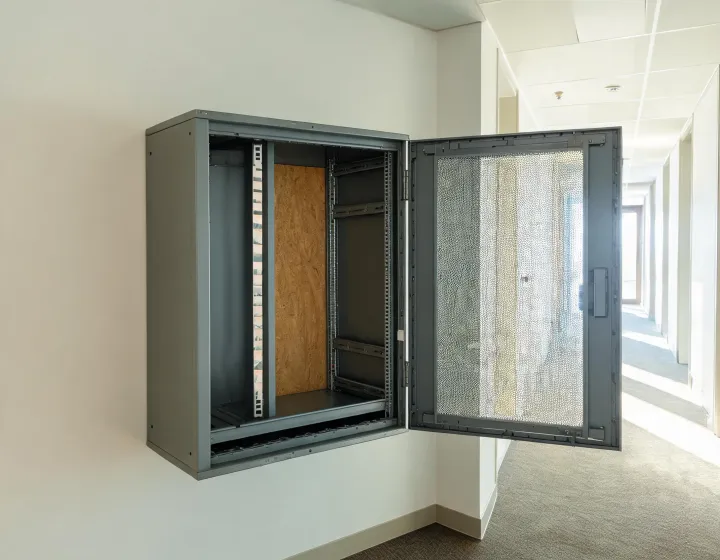
Quote scope that has to name one cabinet
US volume for the phrase 15u wall mount server rack was 20 in the review file dated 27 October 2026. The figure marks why the checklist exists. It is not a count of closets visited and not a capacity claim.
Rail and steel
One rack unit is 1.75 in, which is 44.45 mm. Fifteen rack units are therefore a 26.25 in rail opening, or 666.75 mm. Write that opening, then write the outer skin. EIA-310 also sets the 19 in nominal panel and the hole repeat of 0.625 in, 0.625 in, and 0.500 in. Square holes, tapped 12-24 holes, or a mix must come from the drawing revision, not from a family photo.
Usable depth is the space behind the front rail after the door. A 450 mm outer shell and a 600 mm outer shell are different cartons and different closet fits. A 90 degree swing and a 110 degree swing need different clear floor. State the hand as seen from the room. Stud spacing is often 16 in on center. A plywood backer of 19 mm is a different assembly from drywall alone. If a brochure cites 60 kg, ask whether that is uniform rail load or a point load, and whether anchors are inside the price.
Lines that are not the steel
A 24-port or 48-port RJ45 panel stays on its own row. Category, T568A or T568B, insertion loss, return loss, and 100 ohm impedance are channel or jack results. Connector mating cycle is the cycle count on the jack sheet. Power over Ethernet is a switch power budget. Switching capacity and forwarding rate describe that switch. Runtime, outlet count, and efficiency describe a UPS or PDU if you added one. They do not describe an empty 15U body.
Fiber, if it passes through the cabinet, is another row: wavelength, dispersion, optical budget, receiver sensitivity, and transmit power. Radio gear adds VSWR, gain, MIMO, channel width, and frequency range. Measurement accuracy and calibration traceability are requested when a supplier cites a lab load report: laboratory name, method, and the date on the report. Ingress protection is requested when the room is dusty or wet. This checklist will not assign an IP code. FCC equipment authorization and an NRTL mark follow the active device when the file names that model. ISO 9001, if a supplier offers it, describes a quality system, not this rail.
Two arguments to keep side by side
New versus refurbished is the condition argument for a 15U wall body. A new cabinet can carry a current drawing, a stated load method, and a warranty written against that model, which can make lifecycle and support easier to read. A refurbished cabinet can cover a discontinued hole pattern or a legacy closet when the seller lists bent rails, missing cage nuts, paint over holes, remaining support, and the warranty text that still applies. Provenance and licensing questions sit with the seller. This desk records both positions and does not convert either into inventory.
OEM-coded versus compatible jacks is the second argument when a panel is quoted with the cabinet. An OEM-coded jack may align more directly with a vendor support policy. A compatible jack may broaden the supplier list when plating, category, and the mating-cycle figure are verified for the exact cutout and the exact host panel. A matching RJ45 outline does not settle alien crosstalk. Host compatibility of a switch placed on the rails is unproven until that switch depth and this usable depth are checked together.
A third argument is the hinge and the swing, which are steel and floor space, not the electronics inside the box. Write the hand as seen from the room, and whether a 90 degree swing or a 110 degree swing fits the closet. Neither the equipment you mount later nor its cabling changes that hinge.
Worked intake, marked as a scenario
Background: in a 2026 hallway IDF exercise, a buyer wrote six cabinets, a 15U rail opening of 26.25 in (666.75 mm), an outer-depth cap of 450 mm, a right-hand hinge, and a 19 mm plywood backer. A 24-port RJ45 panel was held as its own line, destination was one US dock, and timing was left as a week count starting at drawing approval.
Process: each factory was asked to mark square holes versus 12-24, the swing in degrees, whether anchors were included, and any deviation such as a 600 mm body. Blank cells stayed blank. A cited load figure had to name the test pose. Currency was USD and the optional budget was labeled per cabinet rather than whole order. Supplier preference was left undecided, which is a buyer note and not a grade.
Result: replies could be lined up on those cells. A 600 mm body that missed the 450 mm cap was rejected as a deviation, not averaged into the others. No saved percentage was calculated, and the exercise was not a completed installation by this desk.
A second scenario kept the same rail height and asked for a refurbished body beside a new body. The refurbished offer had to list missing hardware and remaining coverage. The new offer had to attach a drawing date. Both stayed on the sheet as alternatives. The buyer could accept one, both, or neither. The checklist does not pick.
Limits that stay visible: no audited plant list, no statement that two unnamed models interoperate, and no freight or duty folded into a silent total. Incoming inspection is still the buyer step after shipment: count cabinets, check hinge hand, and match the drawing revision before the carton is accepted. Read the hinged closet notes or the inquiry labels when the measurements are in hand.
Evidence questions before an alternative is accepted
-
Which file is tied to the model on the bill of materials?
A current datasheet or drawing with the revision, the hole type, and the load-test basis. A family brochure can frame the question. It cannot prove the unit you would buy. If a lab number is cited, ask for calibration traceability: who tested, which method, and which date.
-
What must a deviation column contain?
A deeper body, a reversed hinge, tapped rails instead of square holes, a fan tray, or a shelf. Data rate of the copper channel, optical budget, and radio gain stay out of that column because they are not cabinet properties. The supplier splits compliant lines, deviations, and options.
-
Which costs stay outside the cabinet unit price?
Packing, freight, duties, fans, the RJ45 panel, and anchors, unless the line item names them. Incoterm and currency sit in the commercial block. A per-cabinet budget and a whole-order budget are different ceilings. Label the one you mean.
Send the checklist for a spec review
- 26.25 in rail opening
- Usable depth after the door
- Hinge hand and swing
- Wall substrate
- Panel on its own line
Add quantity, destination, and timing in the requirement box. Optional budget needs a currency and a per-cabinet or whole-order basis. A preference of high-end, mid-range, budget, or undecided can be added and is not a verified rating.