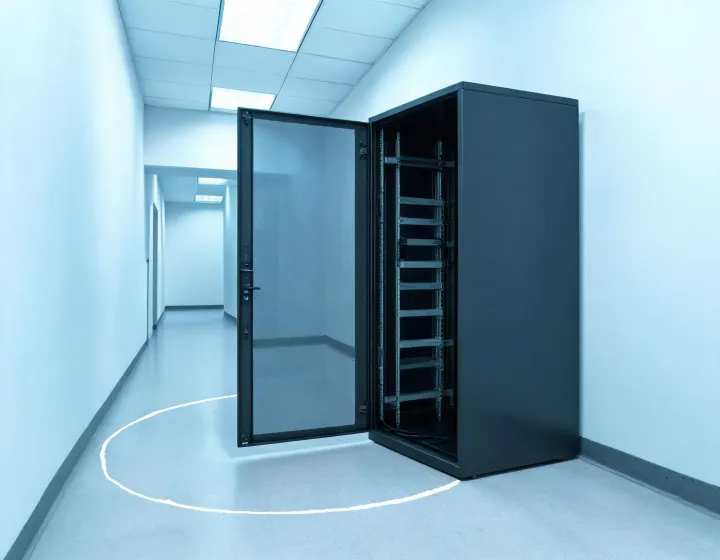
Quote scope for a closet, not a product family
| Scope row | Hinged body | Fixed cabinet in the same closet |
|---|
| Rear access after mounting |
Body swings off the wall plate so the back of a patch field can be dressed. |
Rear access is whatever existed before the screws went in. Later changes may require taking the box down. |
| Structure |
Hinge pins, latch, and the wall plate are extra parts. Ask who supplies the pins and the rated cycle if any is stated. |
Fewer moving parts. The door may still hinge, which is not the same as a swinging body. |
| Load path |
Load transfers through the hinge plate into the wall. A 60 kg uniform figure must say whether it was tested with the body closed, open, or both. |
Load path is the back pan and the anchors. The test pose still has to be named. |
| Price extras |
Swing clearance hardware, latch, and sometimes a second lock. Freight class can change if the hinge barrel increases carton size. |
Often a smaller carton. Still list fans, shelf, and panel outside the steel price. |
Rail math stays fixed while the hinge changes: 12 units are 21.00 in (533.4 mm) of opening and 15 units are 26.25 in (666.75 mm). EIA-310 hole spacing of 0.625 in, 0.625 in, 0.500 in is the pattern to confirm on the drawing. Environment of the closet, connector type on any panel, and port count are adjacent rows. Power rating appears only with a PDU. Accuracy of the buyer measurement is a tape on the swing arc, not a calibrated lab.
Condition argument, both columns kept
Buying new can keep the hinge hardware on a current revision with a warranty that names the model. Buying refurbished can be the route when the closet already matches an older plate, provided the seller lists pin wear, latch play, painted holes, and what warranty remains in October 2026 terms of the offer, not as a site history. This page does not prefer a column.
Jack origin is the second argument when the hinged cabinet is quoted with a copper field. OEM-coded modules can follow a vendor policy with less translation. Compatible modules can be sourced more widely after insertion loss, return loss, 100 ohm impedance, and the mating-cycle number are read from the exact jack sheet. Neither the jack nor the equipment later bolted inside is decided by the hinge.
Scenario used for training the brief, not a customer case: a branch IDF with 16 in stud centers, a 19 mm plywood backer, a left-hand hinge, and a 24-port RJ45 field kept separate. Process: mark the floor arc, photograph the studs, and send both a hinged and a fixed quote request on the same rail count. Result the buyer should expect: two answer sets that can be rejected if the arc or the anchors are wrong. No savings figure is attached.
Limits: the desk will not declare the wall safe and will not set a code path. Bend radius of any cable dressed through the swing still has to clear the hinge.